MY PRACTICE

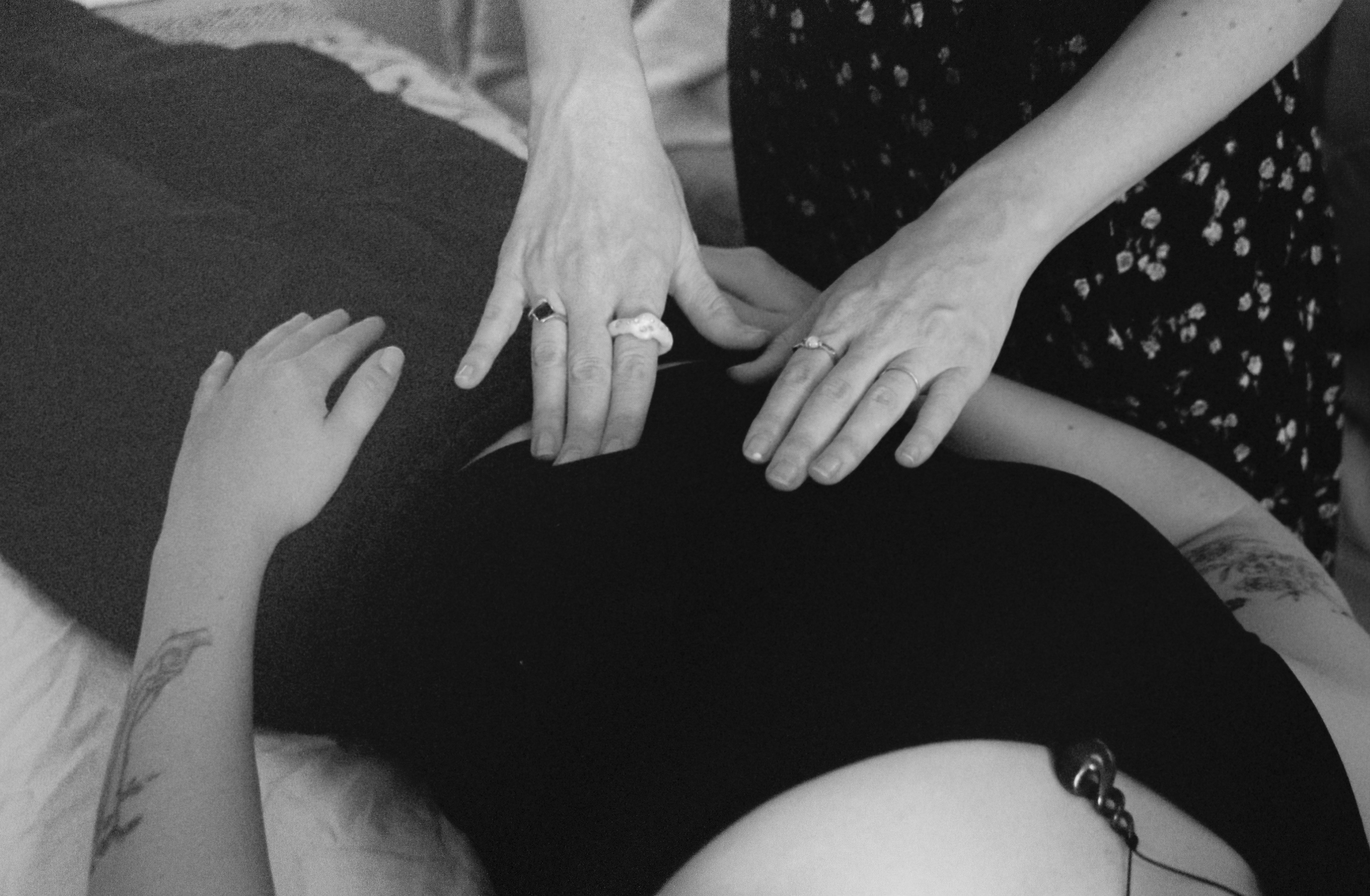
PHOTOGRAPH OF POINT HOLDING BY HOLLIE RUTH

PHOTOGRAPH OF POINT HOLDING BY HOLLIE RUTH

For over a decade, I worked in community development in efforts against mass incarceration and for housing justice, work that put me in the space between what a person carries individually and what a community carries together. And the longer I did that work, the more I understood that these are not two separate things. That liberation, if it is real, has to happen in both places at once. That a body cannot get free from the outside without also tending to what that body is holding on the inside, and you cannot tend to what a body is holding without understanding the systems that created it. That understanding is what led me to somatics, a space for experiencing the possibility of the everchangingness in your own body and how that very same possibility exists in the body of a collective.

I come to my somatic work through many teachers and traditions, not one single method: Embodied Ancestral Inquiry, PsychoNeuroEnergetics, Somatic Release Technique, the Points Holding Process, and more. Unbound by the traditional frameworks of clinical therapy, my intent is to offer a generative, emergent practice that evolves alongside me and others, that stays alive, that pulls from many sources of wisdom to meet the person in front of me as they actually are.

WHAT IS SOMATICS?

Somatics comes from the Greek word soma, meaning “body.” The word, as it is most often used today, describes a field of bodywork and movement studies focusing on internal physical perception and the mind-body connection. Somatics is a broad term and has many applications stemming from various lineages and teachers across time. Before colonization, many of our ancestors practiced somatics as connecting to the body as part of their day to day lives through dance, song, breath, storytelling, and simple togetherness. Presently, this way of being in our lives with our bodies is largely unconventional and is also why reconnecting to our bodies creates this felt sense of homecoming, returning to something that has always been true.

WHO IS SOMATICS FOR?

Somatic work may be for those who:

• Feel stuck in the body and/or mind

• Are curious to understand how their body has experienced and is experiencing their inner and outer worlds

• Have spent years in talk therapy and may feel like there's more to explore

• Simply want a safe space to slow down and listen to what the body has to say


For over a decade, I worked in community development in efforts against mass incarceration and for housing justice, work that put me in the space between what a person carries individually and what a community carries together. And the longer I did that work, the more I understood that these are not two separate things. That liberation, if it is real, has to happen in both places at once. That a body cannot get free from the outside without also tending to what that body is holding on the inside, and you cannot tend to what a body is holding without understanding the systems that created it. That understanding is what led me to somatics, a space for experiencing the possibility of the everchangingness in your own body and how that very same possibility exists in the body of a collective.

I come to my somatic work through many teachers and traditions, not one single method: Embodied Ancestral Inquiry, PsychoNeuroEnergetics, Somatic Release Technique, the Points Holding Process, and more. Unbound by the traditional frameworks of clinical therapy, my intent is to offer a generative, emergent practice that evolves alongside me and others, that stays alive, that pulls from many sources of wisdom to meet the person in front of me as they actually are.

WHAT IS SOMATICS?

Somatics comes from the Greek word soma, meaning “body.” The word, as it is most often used today, describes a field of bodywork and movement studies focusing on internal physical perception and the mind-body connection. Somatics is a broad term and has many applications stemming from various lineages and teachers across time. Before colonization, many of our ancestors practiced somatics as connecting to the body as part of their day to day lives through dance, song, breath, storytelling, and simple togetherness. Presently, this way of being in our lives with our bodies is largely unconventional and is also why reconnecting to our bodies creates this felt sense of homecoming, returning to something that has always been true.

WHO IS SOMATICS FOR?

Somatic work may be for those who:

• Feel stuck in the body and/or mind

• Are curious to understand how their body has experienced and is experiencing their inner and outer worlds

• Have spent years in talk therapy and may feel like there's more to explore

• Simply want a safe space to slow down and listen to what the body has to say


For over a decade, I worked in community development in efforts against mass incarceration and for housing justice, work that put me in the space between what a person carries individually and what a community carries together. And the longer I did that work, the more I understood that these are not two separate things. That liberation, if it is real, has to happen in both places at once. That a body cannot get free from the outside without also tending to what that body is holding on the inside, and you cannot tend to what a body is holding without understanding the systems that created it. That understanding is what led me to somatics, a space for experiencing the possibility of the everchangingness in your own body and how that very same possibility exists in the body of a collective.

I come to my somatic work through many teachers and traditions, not one single method: Embodied Ancestral Inquiry, PsychoNeuroEnergetics, Somatic Release Technique, the Points Holding Process, and more. Unbound by the traditional frameworks of clinical therapy, my intent is to offer a generative, emergent practice that evolves alongside me and others, that stays alive, that pulls from many sources of wisdom to meet the person in front of me as they actually are.

WHAT IS SOMATICS?

Somatics comes from the Greek word soma, meaning “body.” The word, as it is most often used today, describes a field of bodywork and movement studies focusing on internal physical perception and the mind-body connection. Somatics is a broad term and has many applications stemming from various lineages and teachers across time. Before colonization, many of our ancestors practiced somatics as connecting to the body as part of their day to day lives through dance, song, breath, storytelling, and simple togetherness. Presently, this way of being in our lives with our bodies is largely unconventional and is also why reconnecting to our bodies creates this felt sense of homecoming, returning to something that has always been true.

WHO IS SOMATICS FOR?

Somatic work may be for those who:

• Feel stuck in the body and/or mind

• Are curious to understand how their body has experienced and is experiencing their inner and outer worlds

• Have spent years in talk therapy and may feel like there's more to explore

• Simply want a safe space to slow down and listen to what the body has to say


WHAT IS A TYPICAL SESSION LIKE?

Whether we're meeting in person or virtually, every session begins by slowing down together. We check in, ground into the body, and notice what's present: a topic, a theme, a sensation, whatever wants to be followed.

Most of us move through our days at a pace that asks a lot of our body and gives it very little space and time to respond. So we start by slowing down enough for the body to actually be heard. There's often a lot of sensation right at the surface in the beginning, simply because it hasn't had anywhere to go. We notice it together, and as we do, the body starts to unwind.In person, this settling often includes gentle, steady pressure on two points at the base of your skull, right where your neck meets your head, known in Traditional Chinese Medicine as the "Wind Pool" points, and close to where the vagus nerve, a major nerve involved in calming the nervous system, runs as it leaves the skull. In my experience, and in the somatic and polyvagal-informed traditions I’ve trained in, holding these points can help the body settle into a state of inward awareness, creating space for old patterns of stress or trauma to surface, be felt, and, when the body is ready, safely release. 

Virtually, we work with the same settling process through breath, guided attention, and verbal tracking of sensation instead of touch.

From there, we track what's happening. Sometimes I guide it, sometimes the client does, often it moves back and forth. We explore bodily sensations which often lead to emotions and/or feelings and then memories and/or images. We take our time here and stay curious, letting the body show us what's ready to be explored.

When something surfaces — a story, a belief, an identity that got cemented somewhere along the way — we get to experiment and be creative together about how to work with it. Here, I draw on my experience with PsychoNeuroEnergetics, parts work, transactional analysis, Buddhist principles, and somatic release to support the client's process.

To close, we come back to ordinary consciousness (how we walk around in everyday life) and process a bit to help integrate what came up. If possible, I also recommend clients give themselves some time and space after the session to care for themselves however is needed, utilizing soothing practices like writing, movement, napping, talking with a friend, or being outside.

OFFERINGS